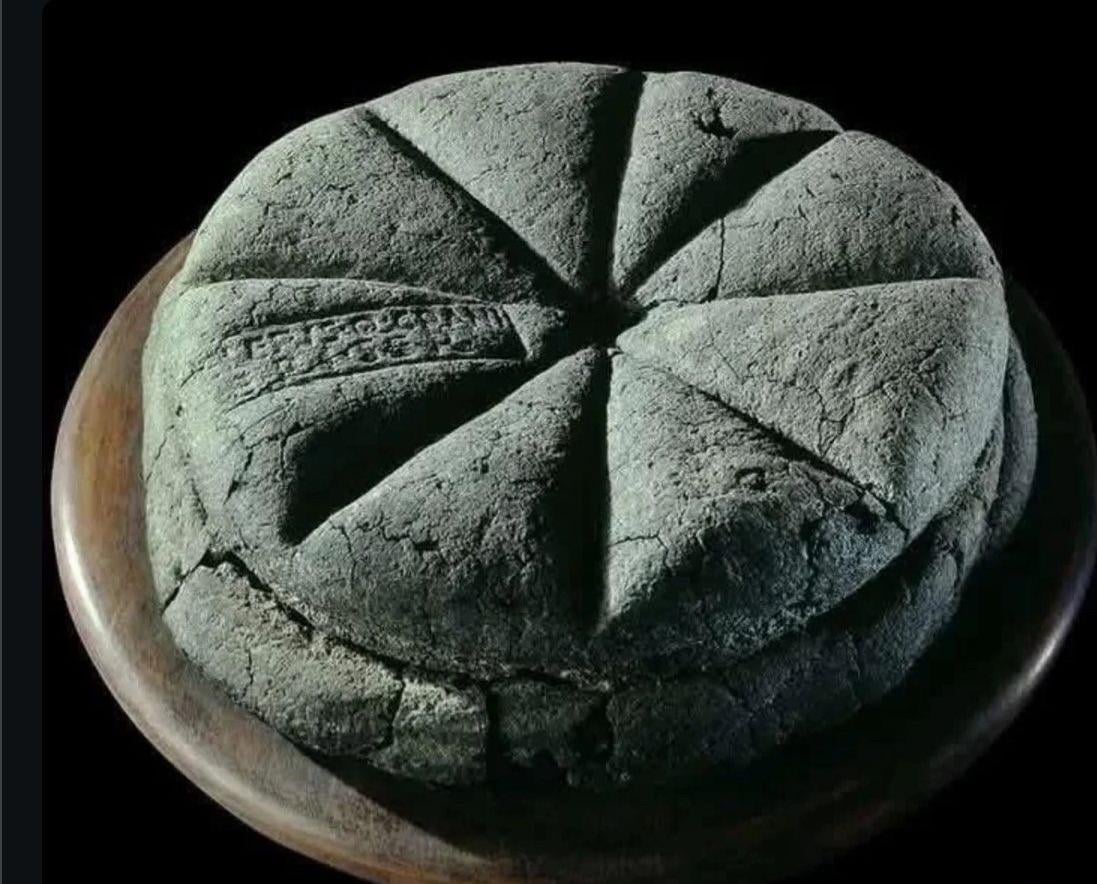
Bread baked on the morning of August 24, 79 AD (the day of the eruption of Mount Vesuvius and the destruction of the ancient Roman city of Pompeii). The loaf was preserved in the oven.
Xpost fr
by StickTrick27
19 Comments
Maverick-Mav
What, no crumb shot?
xMediumRarex
Man that’s cool, grim, but cool. Crazy to think it was just another day, everyone shuffling around, making bread. Wonder what they’d think if they knew people from today would see their bread.
Strange_March6447
Might want to adjust baking time and/or temp on that one
That’s exactly what I’d want my legacy to be, look at that beauty
gbtarwater
Crack it open so we can see the crumb!
Dependent_Stop_3121
Oh nice that’s my families scoring design and hieroglyphics.
/s
MasterChiefmas
A fine example of Discworld dwarf bread.
wasthespyingendless
Here’s some answers from Gemini to the questions I had about it:
The loaf of bread from 79 AD Pompeii, known as Panis Quadratus, features distinct scoring and was made using specific baking methods and ingredients common in ancient Rome. The scoring on the top, which divides the loaf into eight wedges, was primarily practical, allowing the bread to be easily broken and shared into roughly equal portions. These indentations were likely pressed into the dough using a tool like a reed or dowel, rather than being cut with a knife, to prevent the dough from splitting during baking. The horizontal indentation, or “beltline,” around the circumference of the loaf has several possible explanations. It might have resulted from tying string around the dough to help it maintain its shape, ensure uniform size for commercial sale, or even to facilitate carrying multiple loaves. Alternatively, this groove could have been a byproduct of the shaping process itself or a technique to prevent the dough from spreading excessively in the oven.
The bread discovered in Pompeii, especially from commercial bakeries where many such loaves were found, would have been baked in large, wood-fired ovens. These ovens, known as a furnus, were typically substantial, domed, beehive-shaped structures built with brick and ceramic to retain high temperatures for even baking and high-volume production. These were essentially larger versions of smaller, domestic ovens. For smaller-scale or home baking, Romans might have used portable earthenware or metal covers called a clibanus, or pottery vessels known as a testum, which would be placed over dough on a hot hearth or embers.
While no exact recipes for Panis Quadratus from Pompeii survive, analysis of the carbonized loaves and other archaeological and textual evidence allows for informed reconstructions. The primary flour was likely a coarse, whole wheat variety, probably common wheat (Triticum aestivum) or durum wheat (semolina), rather than spelt, which is sometimes mistakenly suggested. It was a sourdough bread, leavened with a natural starter. The fundamental ingredients would have been coarse whole wheat flour, water (creating a relatively stiff, low-hydration dough), and salt. Some Roman breads were also flavored, and literary sources suggest possible additions like poppy seeds, fennel seeds, parsley, or Roman coriander (git). The process involved mixing a starter with water and flour, adding salt and any flavorings, then kneading the dough and allowing it to ferment and rise over several hours or even longer, with periodic kneading. The dough would then be shaped into a round, somewhat flattened ball, the characteristic indentations would be made, and finally, the loaf would be baked in a hot oven. The resulting bread would have been dense with a firm crust, making it easy to break apart for eating with accompaniments like olive oil or cheese, or for scooping other foods.
buddhistbulgyo
is that a branded bread loaf? did humanity lose that technology?

19 Comments
What, no crumb shot?
Man that’s cool, grim, but cool. Crazy to think it was just another day, everyone shuffling around, making bread. Wonder what they’d think if they knew people from today would see their bread.
Might want to adjust baking time and/or temp on that one
https://m.youtube.com/watch?v=DYTuNXq1eBk
Super over baked
Next time try a lower oven temp
I wonder what they named their starter.
That’s exactly what I’d want my legacy to be, look at that beauty
Crack it open so we can see the crumb!
Oh nice that’s my families scoring design and hieroglyphics.
/s
A fine example of Discworld dwarf bread.
Here’s some answers from Gemini to the questions I had about it:
The loaf of bread from 79 AD Pompeii, known as Panis Quadratus, features distinct scoring and was made using specific baking methods and ingredients common in ancient Rome. The scoring on the top, which divides the loaf into eight wedges, was primarily practical, allowing the bread to be easily broken and shared into roughly equal portions. These indentations were likely pressed into the dough using a tool like a reed or dowel, rather than being cut with a knife, to prevent the dough from splitting during baking. The horizontal indentation, or “beltline,” around the circumference of the loaf has several possible explanations. It might have resulted from tying string around the dough to help it maintain its shape, ensure uniform size for commercial sale, or even to facilitate carrying multiple loaves. Alternatively, this groove could have been a byproduct of the shaping process itself or a technique to prevent the dough from spreading excessively in the oven.
The bread discovered in Pompeii, especially from commercial bakeries where many such loaves were found, would have been baked in large, wood-fired ovens. These ovens, known as a furnus, were typically substantial, domed, beehive-shaped structures built with brick and ceramic to retain high temperatures for even baking and high-volume production. These were essentially larger versions of smaller, domestic ovens. For smaller-scale or home baking, Romans might have used portable earthenware or metal covers called a clibanus, or pottery vessels known as a testum, which would be placed over dough on a hot hearth or embers.
While no exact recipes for Panis Quadratus from Pompeii survive, analysis of the carbonized loaves and other archaeological and textual evidence allows for informed reconstructions. The primary flour was likely a coarse, whole wheat variety, probably common wheat (Triticum aestivum) or durum wheat (semolina), rather than spelt, which is sometimes mistakenly suggested. It was a sourdough bread, leavened with a natural starter. The fundamental ingredients would have been coarse whole wheat flour, water (creating a relatively stiff, low-hydration dough), and salt. Some Roman breads were also flavored, and literary sources suggest possible additions like poppy seeds, fennel seeds, parsley, or Roman coriander (git). The process involved mixing a starter with water and flour, adding salt and any flavorings, then kneading the dough and allowing it to ferment and rise over several hours or even longer, with periodic kneading. The dough would then be shaped into a round, somewhat flattened ball, the characteristic indentations would be made, and finally, the loaf would be baked in a hot oven. The resulting bread would have been dense with a firm crust, making it easy to break apart for eating with accompaniments like olive oil or cheese, or for scooping other foods.
is that a branded bread loaf? did humanity lose that technology?
What’s the inscription say?
Can we get the recipe?

[removed]
Looks over proofed
Any idea what the printing says?